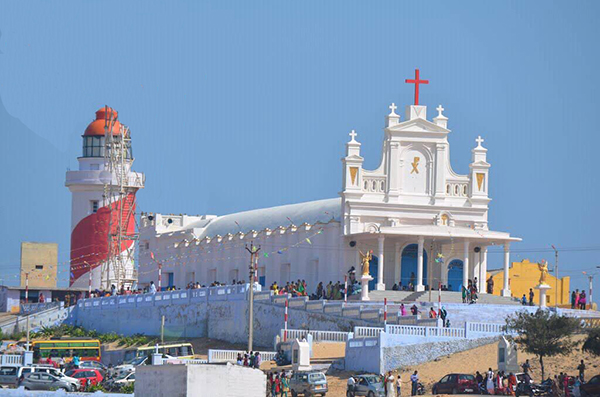
History of Holy Cross Shrine
The feast of the Exaltation of the Holy Cross is celebrated annually by the Catholic Church on 14th September, as one of thanks giving for the recovery of the True Cross from the Persians by the great Emperor Heracuius. Fragments of the True Cross were in due course, brought from Jersusalem to many churches dedicated to the Holy Cross in the East and West. These churches sought to imitate the solemn ceremonies in use at Jerusalem in order to do homage to the Holy Cross. Possibly one of the earliest dedications to the Cross in India was the Church of the Holy Cross in Manapad. Throughout the year many pilgrims visit the church and thousands congregate during the festive season from first to fourteenth September. TRADITIONAL ORIGIN OF THE CHURCH Tradition has it that around 1540, a Portuguese trading vessel while sailing around the Cape of Good Hope, on its way to the East encountered a violent storm and had its sails split and the hind mast snapped. The vessel ran the risk of being foundered. The Captain who was devoted to the veneration of the Holy Cross, implored and entrusted the safety of the vessel and that of the cre to the crucified Christ. He also made a vow that he would construct a Cross from a portion of the splintered mast and has it implanted on the shore where they alight in safety. Perchance, the vessel after having drifted for several days sought haven in then then well known port of Kulesakharapatnam-Manpad. In fulfillment of his vow, the Captain had the Cross planted on the top of the hillock forming the natural Southern arm of the harbor. The Captain erected over the cross a small hut as protection against possible ravages of weather. REVELATION The first miracle is said to have occurred when the cross was still in the nude form of a log cut off from the broken mast. It is said that when the log was laying on the shore an inhabitant of the village who had trampled on filth had cleansed his foot on this log. No sooner had he wiped his leg than he felt a pain and instantaneous swelling of the leg too. It was with the greatest difficulty that he was able to return home. That night the man had vision in which it was revealed to him that the ailment was due to his defiling the log of wood intended for a sacred purpose, He was asked to wipe the much off the log, smear the log with oil and then apply the same oil to the affected foot to get cured. Early next morning, the patient was carried to the spot where the log was and the to amazement of the crowd that had collected there, there was immediate cure and the man was able to walk back home unaided. This remarkable happening made the occasion of the planting of the Cross by the Captain an event of great piety and festivity. From then onwards, the name and fame of the Captain's cross spread throughout the Coromandel coast. ARRIVAL OF ST.FRANCIS XAVIER Manapad was mostly inhabited by the Paravars who had embraced Christianity in 1532; but, for want of missionaries, the neophytes remained nominal Christians, until the arrival and ministration of St.Francis Xavier, The saint who arrived in Manapad in October 1542 found two spots which impelled him to choose Manapad as his favorite haunt during his sojourn in the Pearl Fishery Coast. One was the presence of a grotto carved out of the rocky ledge, which he preferred to use as his abode. This cave was known in pre-Christian era as "Valli's cave", a counterpart of the one at Tiruchendur. It is now a signal grotto having at its outer entrance the stone tablet bearing the inscription: "This cave, the dwelling of a saivite sanyasi has been sanctified by the prayers and penance of St.Francis Xavier". The lonely hermitage with just the stars and the sea to keep company, chosen by Francis Xavier depicts his thirst for austerity and renunciation. Inspired by the Biblical exhortation, "What doth it profit a man, if he gain the whole world, and suffer the loss of his own soul?" he cast to the winds the professorship attached to the University of Paris and joined the Society of Jesus in answer to the clarion call of the Founder of the Society, St.Ignatius of Loyola. No wonder then, that here joiced to take up abode in this cave. The other spot that induced him to choose Manapad with rapturous delight was the Captain's Cross with its raised platform and an overhead covering, almost providing a built-in chapel enabling him to offer daily the Sacrifice of the Holy Mass. St.Francis Xavier toiled among the Paravars, instructing and ministering all along the Pearl Fishery Coast until November 1543 when he returned to Goa. He was again at Manapad in March, June, August and September 1544 and went to Travancore in November. A MIRACLE EVOKES AND ENSURES FAITH To the people of Mnapad, St.Francis Xavier was much more than a preacher of the Gospel of Christ. He was first and foremost a friend to all. His austere life, his tenderness coupled with stern standards in the observance of morals and above all his revered advice to all problems posed, made people to flock to him in large numbers. During his sojourn there, with the help of the pundits of Manapad he translated the rudiments of the common prayers and trained the first batch of catechists. And God, in appreciation of the self-abnegation of His dearly beloved son Francis Xavier provided him with an occasion to perform the first miracle of his life which had such an impact that the people in and around Manapad started venerating him as a saint long before he was canonized by the Church. The incident was this : While at Manapad, the saint had two youngsters trained as acolytes to aid him